Stories
A Case Study of Sunflower Sober’s Partnership with the Tenderloin Housing Clinic

Mar 19, 2026
In partnership with Tenderloin Housing Clinic (THC), one of San Francisco’s most established supportive housing providers, Sunflower Sober piloted its addiction recovery app designed to support individuals navigating some of the most complex and underserved circumstances in addiction care. This collaboration focused on residents with histories of incarceration, substance use disorder, and homelessness, which are populations that are both high-need and historically difficult to engage through traditional care models. Our pilot with THC had strong adoption and overwhelmingly positive feedback, so we are excited to now expand Sunflower Sober across its Permanent Supportive Housing portfolio to reach even more residents.
Tenderloin Housing Clinic’s Role in Supporting High-Need Recovery Populations
Tenderloin Housing Clinic plays a critical role in San Francisco’s social infrastructure because it provides housing and supportive services to individuals transitioning out of homelessness, incarceration, and substance use. The THC runs the New Horizons program, a drug-free transitional housing initiative that supports residents as they rebuild stability post-incarceration. THC also operates a network of Permanent Supportive Housing buildings that serve individuals with long-term, complex needs, including co-occurring mental health and substance use disorders. These populations often encounter fragmented access to care, high relapse risk, and significant social isolation, making sustained engagement in recovery particularly challenging.
Identifying the Support Gap in Real-Time Recovery Needs
A key challenge for THC is that despite excellent services, they are not always accessible in the moments when they are most needed. Residents have ongoing cravings, emotional distress, or destabilizing triggers outside of program hours, with limited access to counselors or peer support. This creates a critical gap between structured services and real-world moments of vulnerability. THC therefore sought out a solution that could extend support beyond their physical settings and provide real-time, on-demand assistance to complement and not replace existing care.
The Sunflower Pilot: New Horizons Transitional Housing
Sunflower Sober was introduced through a partnership with Richard Beal, Director of Recovery Services at THC, to pilot Sunflower’s app within the New Horizons transitional housing program. The pilot offered up to 75 residents one year of free, full-access use of the app, with an initial goal of evaluating engagement and efficacy over a 90-day period. Deployment was intentionally embedded within the program, with the Sunflower Sober team participating in group and community meetings at the Drake Hotel, where New Horizons operated, and working closely with Case Managers and leadership to onboard both residents and staff. QR codes placed throughout the facility enabled seamless access, while in-person engagement ensured participants understood the app as a meaningful support tool instead of solely a passive resource.
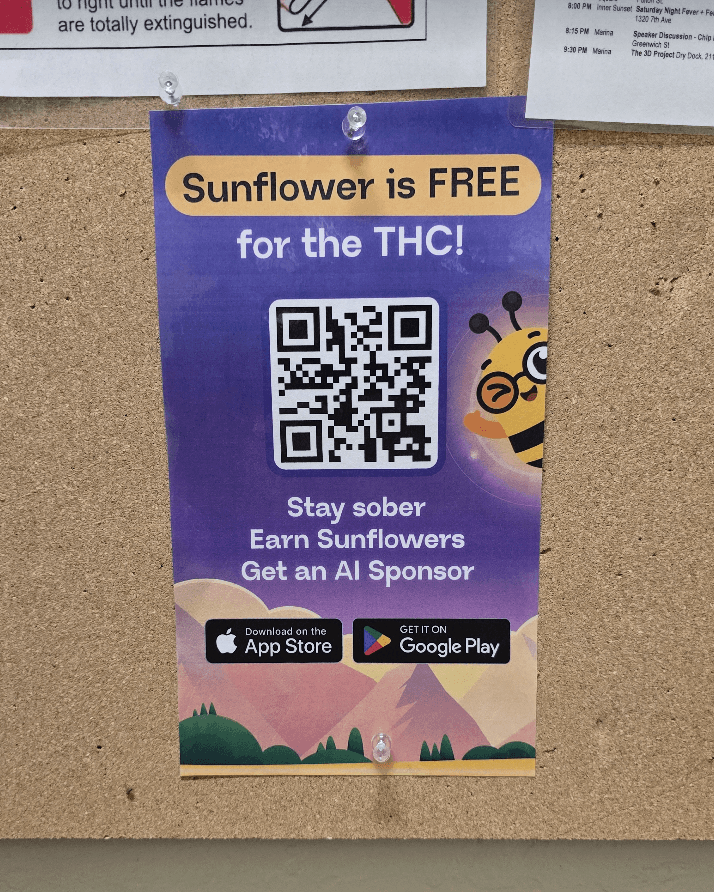
Sunflower flyer in the THC Building
Pilot Engagement & Feedback
The pilot with the Tenderloin Housing Clinic provided an early view into how residents engage with Sunflower in a real-world recovery environment. Residents at onboarding reported challenges spanning both substance use and behavioral addictions, including nicotine, meth, OxyContin, cannabis, cocaine, and Xanax, alongside patterns related to gambling, sex, and food. This diversity underscores that recovery in this population is not singular. Many residents are navigating overlapping dependencies influenced by shared underlying drivers such as stress, isolation, and the need for regulation.
Engagement patterns did not follow a continuous or habitual model. Instead, usage was episodic and context-driven. Residents engaged during moments of heightened need, including periods of craving, emotional distress, or reflection. These interactions were not passive. They were intentional and situational, indicating that the platform is being used as a tool for support rather than as a routine activity. This pattern is consistent with early-stage recovery environments, especially within populations experiencing housing instability. In this context, sustained daily engagement is not the primary indicator of value. The ability of a platform to be accessible and relevant at critical moments is a more meaningful measure of impact.
Residents used several Sunflower app features, including the AI sponsor that is available 24/7 to offer advice and support especially during heightened cravings, the sobriety tracker, and the community feature to be connected with thousands of other people in their sobriety journey. The AI sponsor was especially relevant for the residents with ongoing engagement throughout the pilot. As Felix G., a Housing Planning Specialist at New Horizons, noted, “The AI component is very informative. It actually supports you when you’re having those difficult times.”
Overall, the pilot demonstrates that Sunflower functions effectively as an on-demand support layer to complement existing services within the Tenderloin Housing Clinic. With the success of the New Horizons pilot, THC decided to expand to more locations.

Sunflower Director of City Partnerships, Tom Wolf, & THC Director of Recovery Services, Richard Beal
THC’s Decision to Expand
The decision to expand the partnership emerged from the recognition that recovery support cannot be limited to scheduled services, particularly for high-risk populations. THC recognized that many residents either lack consistent support systems or have not yet fully engaged with available services, and that isolation and loneliness remain significant drivers of relapse. Sunflower Sober addresses this gap by being continuously accessible and offering support at the exact moments it is needed. It functions both as a simple, everyday support tool and as a more intensive relapse prevention companion, helping individuals navigate difficult periods without requiring immediate access to in-person services.
Expansion: Permanent Supportive Housing
Following the success of the pilot, THC is now in the process of expanding Sunflower Sober across multiple Permanent Supportive Housing buildings, with the potential to reach hundreds of residents. This broader population includes individuals in early recovery, as well as people with co-occurring mental health conditions and long histories of instability.
Beyond expansion, this partnership also represents an opportunity to demonstrate value at the systems level. THC and Sunflower Sober aim to show the City and County of San Francisco’s Public Health Department that digital tools can play a meaningful role in addressing addiction, supporting sobriety, and reducing the impact of isolation. By complementing existing services rather than competing with them, Sunflower Sober serves as a scalable, cost-effective intervention that can extend the reach of already overburdened systems.
Toward a New Standard of Care in Recovery Support
The Sunflower Sober and Tenderloin Housing Clinic partnership shows that technology, when thoughtfully integrated with existing care environments, can fill critical gaps in addiction support and unlock new pathways for sobriety at scale. The Sunflower app functions as a constant companion that meets individuals where they are, whether they are actively seeking sobriety or struggling with relapse. Together, THC and Sunflower Sober are transforming recovery support from a service into a continuous system of care.